Automated signups
Scripts and headless browsers create accounts faster than manual review can catch them.
Find out how repeat users, automated accounts and coordinated signups exploit your free trials, credits and promotions—before they quietly become part of your cost of growth.
When one actor can create account after account, your acquisition data, infrastructure planning and unit economics become contaminated. You may be funding abuse while measuring it as growth.
Sample artifacts show how the assessment moves from observed behavior to connected evidence and a report your team can act on.
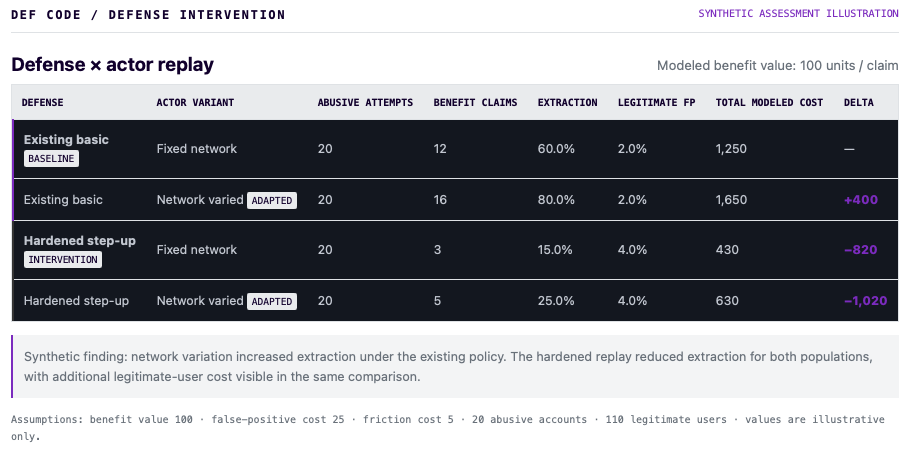
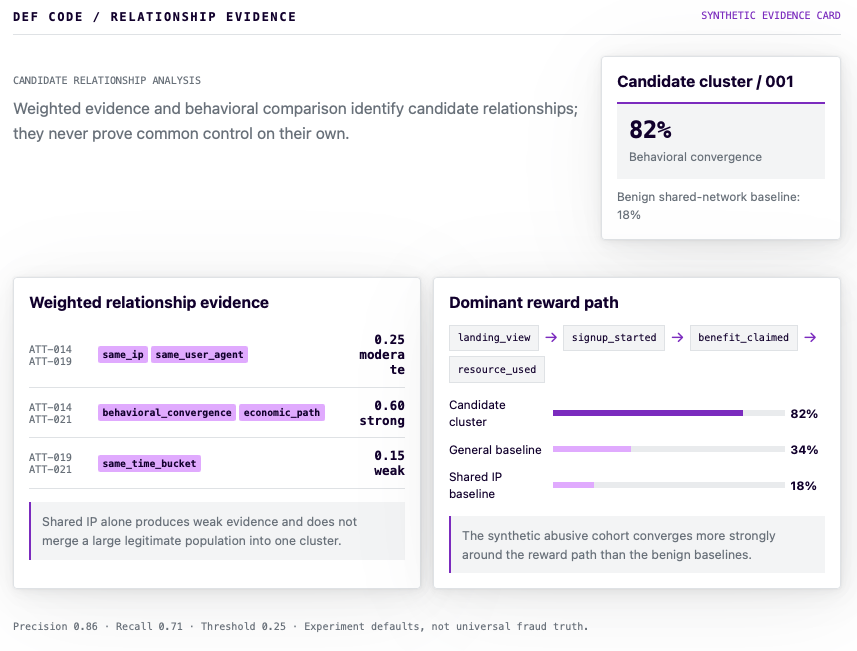
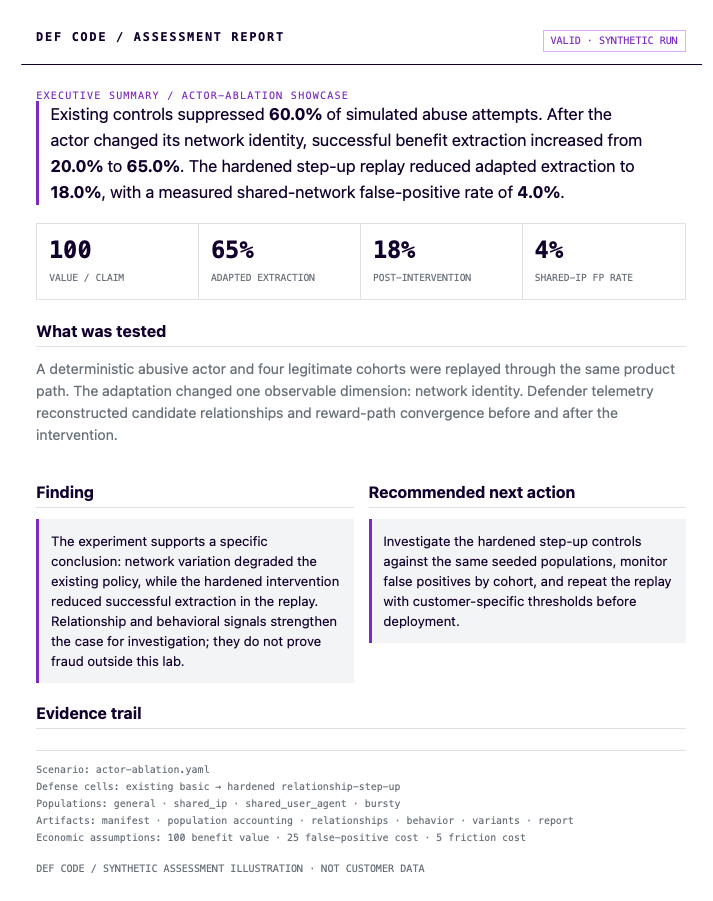
Def Code examines the complete path from account creation to benefit consumption and repeat signup—not only the individual controls in isolation.
Scripts and headless browsers create accounts faster than manual review can catch them.
One person appears as many new customers to repeatedly claim the same incentive.
Abusive accounts consume GPU, voice, messaging and third-party services you pay for.
Fake uniqueness corrupts conversion, retention and customer-acquisition decisions.

I worked on risk detection and user protection at Okta/Auth0, including responding to signup-abuse incidents and developing signals used to identify abusive actors. Def Code brings that experience to SaaS and AI companies whose growth models depend on knowing whether accounts represent real, distinct users.
You work directly with me—from discovery through technical investigation and the final remediation plan.
We identify what an abusive actor can extract, the path required to reach it, and the defenses already protecting that path.
We simulate repeat and automated actors against the product to determine which abuse paths survive the existing controls.
We correlate available network, identity and behavioral signals to identify related accounts and coordinated populations that individual controls can miss.
We change defensive conditions and replay the experiment to determine which controls actually break the abuse path.
We compare attack success, economic exposure and impact on legitimate users to identify the most effective intervention.
Not a generic vulnerability report. Every artifact helps your product, security and engineering teams understand the same abuse problem.
How an actor moves from signup to verification, incentive consumption and repeat signup.
Evidence that supposedly independent accounts may be controlled by the same actor.
Where CAPTCHA, email verification, rate limits, IP controls and current safeguards fail.
A business-readable view of what successful abuse costs—or could cost—the company.
What to fix first, balancing abuse reduction with friction for legitimate customers.
A clear walkthrough for decision-makers, plus enough depth for the team implementing changes.
The assessment is scoped around one product and its signup incentive. You get a clear price, a defined timeline and direct access to the person conducting the work.
In 15 minutes, we’ll determine whether a signup-abuse assessment fits your product, incentive model and current stage.
Book your assessment call